This Holy Week and Easter, the first since my retirement, Sarah and I (and a friend) returned to the beautiful Hilfield Friary near Dorchester in Dorset, a house belonging to the Society of St Francis, an Anglican Franciscan Monastic Order. I say ‘returned’. Actually I have been there many times, most recently in 2018, but the visit I had in mind was 40 years ago with Sarah, one which, in retrospect was a key moment in my vocation.
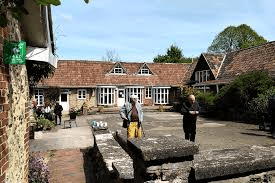
At the time I was a young (26) RE teacher in Cheltenham. My attachment to St Francis and all things Franciscan had grown since two visits to Assisi with university friends in 1979-80 and then a stay at SSF’s contemplative house near Worcester during my teacher training year in 1981. The mixture of the beautiful countryside, the deep peace of the worship in their chapels and the social engagement of the friars , most of whom were based in small houses in cities working alongside the poor during the day and returning to their ‘cells’ at night- all this held a strong appeal to me, seeking, as I was a direction for my life.
I was enjoying RE teaching (notwithstanding its early difficulties with discipline etc) but I wasn’t sure if it was meant to be a lifelong calling. I had already been on a Selection Conference for the C of E Ministry straight after Oxford ,but was told to go away and ‘get some experience of the world, dear boy’. This was of course an initial disappointment, but having trained as a teacher, I felt it was probably right. Looked at from the angle of daily engagement with young people and their energy, the church and its clergy did not appeal, obsessed as they seemed to me, with keeping old and irascible ladies happy and raising funds for church upkeep. Recently I came across a letter I wrote at the time reflecting on the Cheltenham Vicar’s impending move to hospital chaplaincy back in ‘84. This would be much more fulfilling (I reckoned) ‘though I suppose somebody’s got to work with the complacent, middle-aged, successful people of this world’). By contrast the SSF at the time seemed to have plenty of youngish, enthusiastic and socially engaged young people with some of the freedom of St Francis himself, who cared for the poor in the highways and byways around Assisi with his band of brothers.
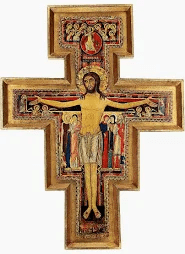
An important step in Francis’ calling occurred when he was praying in front of a crucifix in the broken-down church of San Damiano outside Assisi . He seemed to hear (in answer to the question ‘Lord, what do you want me to do?’ ) the words, ‘Francis, rebuild my church’. At first he took this literally, selling his cloth merchant father’s expensive clothes to buy stones for the church, but when his exasperated parents hauled him in front of the Bishop in Assisi town square to bring him to book, he realised his calling was to something deeper – to reform the whole church, with its mediaeval corruptions- not just an individual building. Casting off his fashionable clothes in which he had delighted, Francis walked off naked into the countryside, covering himself in a simple brown garb which became the Franciscan habit. This seemed to me like an authentic response to Jesus’ words, ‘Go, sell all you have, and come and follow me’ and the freedom and joy it seemed to bring. In the Franciscan Principles it says of this joy that the brothers ‘must remember they followed the Son of Man, who came ‘eating and drinking’, who loved the birds and flowers, who blessed little children, who… sat at the tables of rich and poor alike. They will therefore put aside all moroseness, all undue aloofness, and delight in laughter and good fellowship.’ This was something I wanted to be a part of.
Or did I? At the time I was going out with Sarah (now my wife of nearly 38 years, for whom such thoughts were worrying to say the least), was involved in the local church, beginning to establish myself in a worthwhile profession and had just bought the one and only property I have ever owned. I loved music and culture of all sorts, most of which (and many other things besides) I would have to forsake if I followed down this path. Was I really ready for this?
Hilfield at Easter 1984 was wonderful: warm and bright (unlike the cold and sodden 2024), with new life everywhere, but, encouraged by my soon-to-depart parish priest, I decided to have a second stab at Selection for C of E ministry. This time, the path seemed clearer and brighter and so, after a few meetings with church advisors, as well as one with the SSF Vocations Adviser, I was selected to go forward for priest training in 1985, got married a year later and ordained the next.
So here I am, 40 years on, retired from parish ministry and praying in front of the same copy of that St Damiano crucifix before which St Francis asked ‘What do you want me to do?’ . How does my life and vocation look, as compared to those hopes and ideals of 40 years ago?
My first feeling is of gratitude to be still alive, still reasonably fit, still happily married, with two grown-up children and three grandchildren, and having survived C of E ministry to pensionable age. Such things cannot be taken for granted. Yet these could be the self-satisfied thoughts of one of the complacent middle-aged / elderly people I so didn’t want to minister to in my youth. What about those ideals of joy and service to the poor glimpsed in St Francis and his brothers, then, as now? Have I lost sight of these?
Well, I did become a priest and remained in parish ministry all my career, despite occasional thoughts of other ministries. I found there was more to it than keeping old people happy, interceding between warring factions and raising funds. I was able to apply some of those early Franciscan ideals in community and schools work and Messy Church amongst the poor of Ryde and Ventnor, as well as with many individuals. I was fortunate enough to work in dioceses and parishes which valued links with the wider world, taking me out to Ghana, Poland and Sweden. I also took advantage of Sabbaticals, enabling me to travel across the USA by train, and from South to North Ghana by bus, and write reflections on what I saw. I was also allowed a freedom from direct supervision in my day-to-day ministry that most workers could only dream of. The C of E has been to me a good place in which to minister. ‘You have set my feet in a spacious place.’, as it says in the psalm (Psalm 31:8)
And yet, and yet…At Hilfield in 1984 there would have been over 20 brothers, including novices, now there are 4 (though with a thriving lay community alongside them- see the next post on my blog!). Decline in monastic vocations has gone hand in hand with the general decline in most church congregations (by more than half, at its very best), often with barely a child in sight. We have not ‘rebuilt the church’. Clergy and lay people between us have witnessed the church and its influence in society dwindle to the marginal. Some of this has been our fault, but most of it is down to forces beyond our control. All my inspiring preaching (so people say), warm pastoral care and general popularity in the community has not stopped this. I regret this, and wonder if Hilfield and my former churches will even be there in 40 years.
Such feelings are common and not unique to our age. Francis himself, after an incredibly active and revolutionary life, (taking him from the Umbrian hills to the Holy Land), lying on his death bed, full of pain and nearly blind, was full of depression, fearing his earlier vision had been lost. Yet his influence is still strong, not least in the present Pope. Our times are in God’s hands and despair is generally best avoided.
What’s more, my life (by God’s grace) is not yet finished. Already I have done more amongst different people since my retirement than I planned and I hope still to be useful to church , society and music over the coming years. There is more to life and God than church!
So, as I sit in front of the San Damiano cross in the Hilfield Chapel, once again asking God, ‘what do you want me to do?’ I feel afresh the warmth of that calling and dedicate whatever remains of my life to God and his purposes.
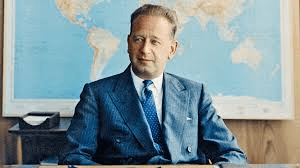
In the words of the great former Secretary General of the United Nations, Dag Hammarskjold, whose life was so cruelly cut short by an accident in the prime of his life, I want to say.
‘For all that has been; thanks! To all that shall be- yes!’
 Hugh's Views